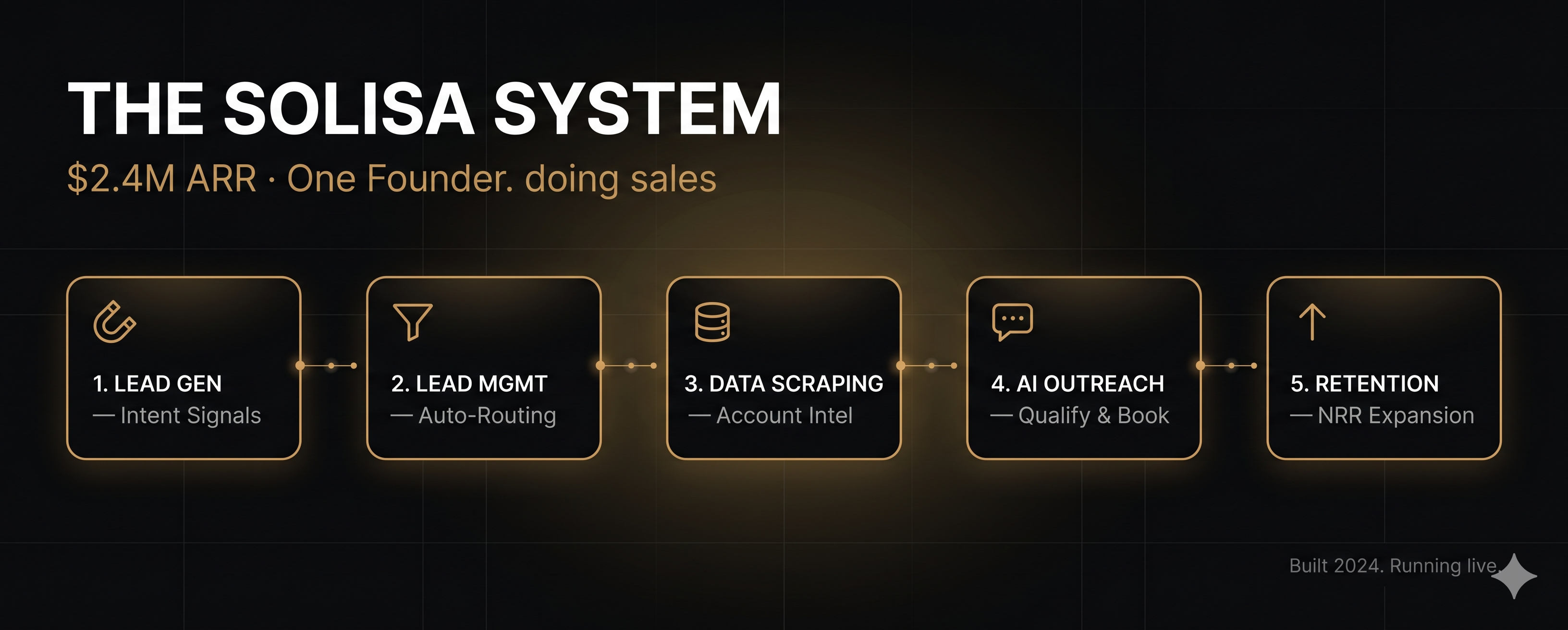
Two years ago I was running outbound at Solisa. Nine enterprise clients. $2.4M ARR. Contracts scaling toward $1M. No SDR team. No BDR team. Just me and a system I built layer by layer.
Here's exactly what I did, what worked, what I'd burn down if I rebuilt it today, and why the same system now costs a fraction of what Fortune 500s still pay their incumbents.
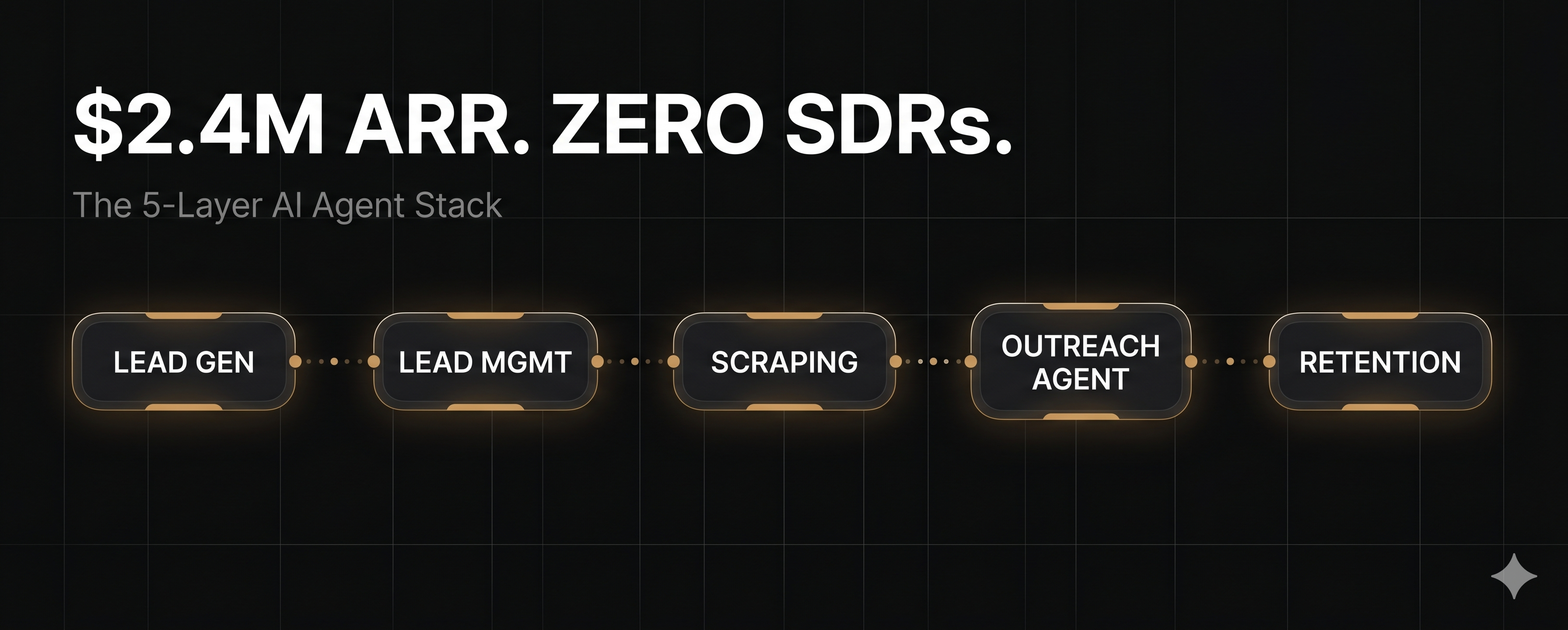
The five-layer stack I built at Solisa
Enterprise sales automation isn't one tool. It's five layers working in sequence. Miss one and the whole thing leaks revenue.
1. Lead generation
I stopped buying static lead lists within the first month. They were dead on arrival. Instead I built a system that pulled intent signals in real time -- hiring data, tech stack changes, funding events, job postings, review site activity on our target accounts. Every lead got scored on fit and timing.
Key Lesson
Timing signals outperformed fit signals 3 to 1. A mediocre-fit account hiring for a role we solved for beat a perfect-fit account with no trigger event, every single time.
2. Lead management
Our leads never sat. The moment one entered the pipeline, an enrichment layer pulled LinkedIn, company filings, recent news, and mutual connections then routed by priority. Hot leads got a personal touch from me. Everything else went to the automated sequence.
Lesson I Wish I'd Learned Sooner
I triaged manually for the first four months. It was the single biggest bottleneck. Automating the routing alone unlocked 40% more conversations.
3. Data scraping
The unsexy backbone of everything. I pulled from job boards, SEC filings, review platforms, social, and news -- then normalized it into a single profile per account. This is what let our outbound sound like a human who did 30 minutes of research on every prospect.
Key Lesson
Structured data beats volume. I'd rather have 200 enriched accounts than 20,000 names.
4. Outreach, warming, and qualification
This is where most founders get it wrong and I almost did too. My first version blasted templates. Reply rates were under 2%. I scrapped it.
The version that worked: every first touch was calibrated to the scraped profile. The system handled the first three replies, qualified against our version of MEDDIC, and booked the meeting straight to my calendar. The only human touch was the demo itself.
This layer handled 80% of top-of-funnel conversations end to end. It's the single biggest reason one founder could run what normally takes a 6-person SDR team.
5. Retention and expansion
This is the layer nobody builds and everyone needs. I almost didn't build it either -- I was so focused on new logos that I ignored the existing book for the first six months.
Then I built retention monitoring on usage signals. It flagged churn risk before customers knew they were churning and surfaced upsell moments based on actual product behavior.
Why I'd build it completely differently in 2026
Here's the honest part. The Solisa system worked, but it was held together with duct tape. I was writing Python scripts at 2am, stitching together seven SaaS tools, and the whole thing cost us $40K+ a year in licenses along with hundreds of thousands in data mining and training.
The 2026 version is unrecognizable.
AI agents now handle entire workflows that used to require custom code. A single agent can do what my entire outreach stack used to do -- and it handles edge cases I never coded for. Retention monitoring that took me three months to build is now a weekend project. The scraping layer that required four different vendors is one agent with the right tools.
The Real Shift
I used to build automations. Now I build agents. Automations do what you told them. Agents figure out what to do. That difference compounds across all 5 layers.
What this means for everyone else
At Solisa, this system justified enterprise contracts because we were selling to enterprise. Fortune 500s are still paying 6 and 7 figures to license the same category of systems from legacy vendors.
The arbitrage isn't in building better AI. It's in deploying enterprise-grade systems to businesses that never had access to them. Gather the data nobody else has and constantly improve.
That's the opportunity. The moat is speed plus data.
| What | Solisa (2024) | Kijestic (2026) |
|---|---|---|
| Stack cost | $40K+/year in licenses | Under $5K/year |
| Build time | 6 months custom Python | Weeks with AI agents |
| Maintenance | Constant duct tape | Self-healing agents |
| Data sources | 4 vendors, manual stitching | Single agent, real-time |
| Outreach | Template-based, 2% reply | Profile-calibrated, 8%+ reply |
| Retention | Built over 3 months | Weekend project |
| NRR impact | 94% to 131% | Same playbook, fraction of cost |
Ready to Deploy Enterprise-Grade AI Sales Automation?
The same five-layer system that generated $2.4M ARR is now available at a fraction of the cost. Let's build yours.
Get Your Free Assessment